3D Reconstruction · Generative Models
GenRecon: Indoor Scene Reconstruction with Generative Priors
Reconstructing a complete, relightable PBR mesh of an indoor scene from a sparse set of photographs, by casting reconstruction as conditional 3D generation.
Overview
Classical multi-view reconstruction pipelines degrade sharply when photographs are sparse: unobserved surfaces produce holes, and photometric inconsistencies corrupt geometry. GenRecon (Schmid et al., 2026) addresses this by reframing scene reconstruction as conditional 3D generation — a generative prior fills in what the cameras did not see, while observed regions constrain the synthesis. This project is a clean, single-library re-implementation of the GenRecon method built on the Trellis 2 generative prior, capable of producing a complete, relightable, physically-based-rendering (PBR) mesh of an indoor room from a handful of casual photographs.
Method
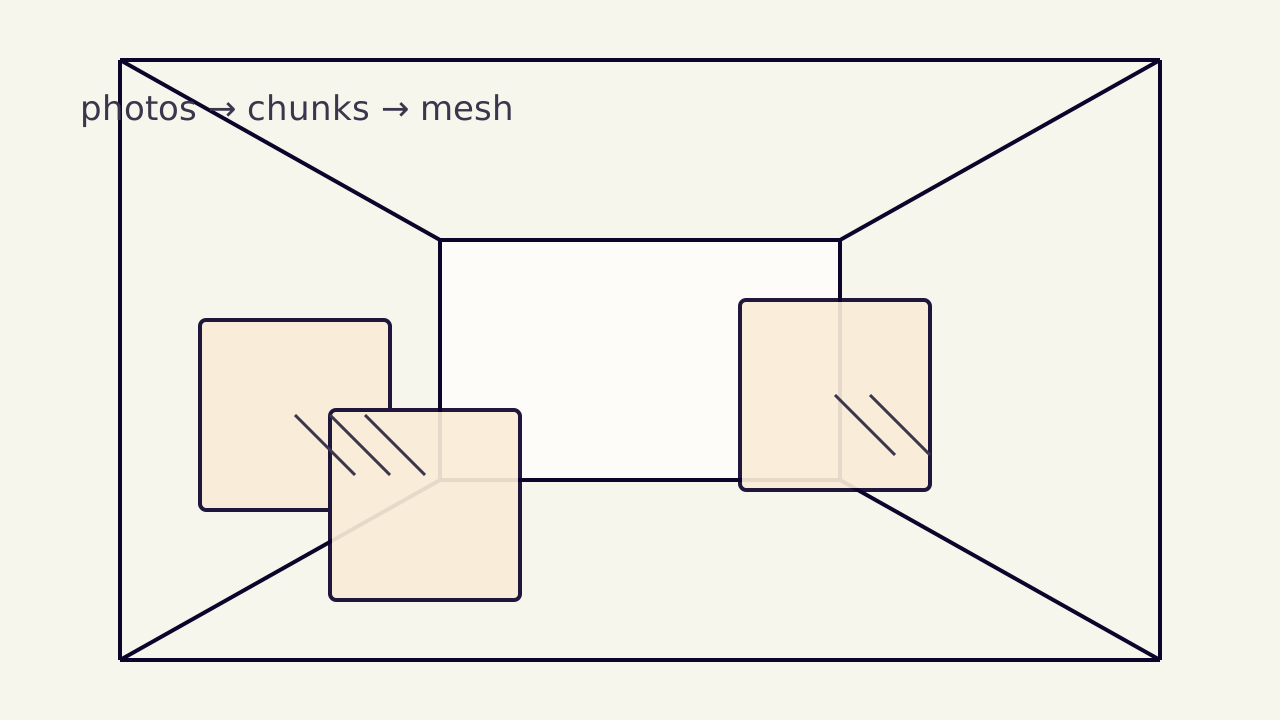
The pipeline proceeds in three stages. First, camera poses are recovered with COLMAP structure-from-motion, falling back to the feed-forward VGGT estimator when classical SfM fails to register the sparse views. Second, the scene is partitioned into overlapping chunks, and each chunk is synthesized by the Trellis 2 generative model conditioned on the posed observations; generating chunk-wise keeps each generation within the prior’s native output volume while preserving local detail. Third, chunks are placed and merged into a single mesh using axis-aligned bounding-box overlap constraints followed by similarity-ICP registration, and the result is previewed under multiple HDRI environments to validate relightability.
Fine-tuning introduces only a small set of new parameters — a LoRA adapter over the prior, per-block 3D-conditioning injection layers, and an IBRNet-style feature aggregator (approximately 55.6 M new and 4.7 M LoRA parameters) — so the generative backbone itself remains frozen. Training progress is monitored on loss, IoU, and Chamfer-distance metrics.
A byproduct of this work was a substantial porting effort to run Trellis 2 on NVIDIA Blackwell-generation GPUs (sm_120) under CUDA 13, documented alongside the implementation.
Results
Reference
Schmid et al., GenRecon: Bridging Generative Priors for Multi-View 3D Scene Reconstruction, arXiv:2605.23888.